
- Written by: Vishal Singh
- February 26, 2026
- Categories: E-commerce
- Tags:
How Do E-commerce Businesses Use Rfm Segmentation to Improve Marketing?
Introduction: Why RFM segmentation has become unavoidable in ecommerce
E-commerce marketing has never had more data, yet many brands still struggle to turn that data into meaningful growth. Traffic is expensive, acquisition costs keep rising, and customers move on faster than ever. What separates brands that grow sustainably from those that plateau is not how much data they collect, but how intelligently they use it to understand customer behavior.
This is where rfm analysis for customer segmentation has quietly become one of the most effective tools in modern ecommerce. Instead of guessing who might buy again, RFM segmentation looks directly at how customers have behaved in the past and uses that behavior to predict future value. It allows marketing teams to move beyond generic campaigns and into precise, revenue-focused personalization.
In this explainer, we will unpack why most customer segmentation in ecommerce fails, how RFM fixes those gaps, and how ecommerce businesses actually use rfm recency frequency monetary insights to improve retention, personalization, and long-term revenue.
Why most ecommerce segmentation still fails
Many ecommerce brands begin segmentation with good intentions but flawed assumptions. Demographic and campaign-based segmentation often underperforms because it describes who customers are rather than how they behave. Knowing a customer’s age or location rarely tells you whether they are likely to buy again, churn, or increase their spending.
The deeper issue is retention. Brands focus heavily on acquisition, but without understanding which customers are worth retaining and how to engage them differently, marketing efforts become inefficient. Blanket discounts, identical email campaigns, and one-size-fits-all messaging erode margins without building loyalty.
RFM segmentation closes this personalization gap by grounding decisions in customer segmentation behavioral data. Instead of guessing intent, it evaluates how recently a customer purchased, how often they return, and how much they spend. This creates a clear, measurable foundation for customer data segm
What is RFM segmentation?
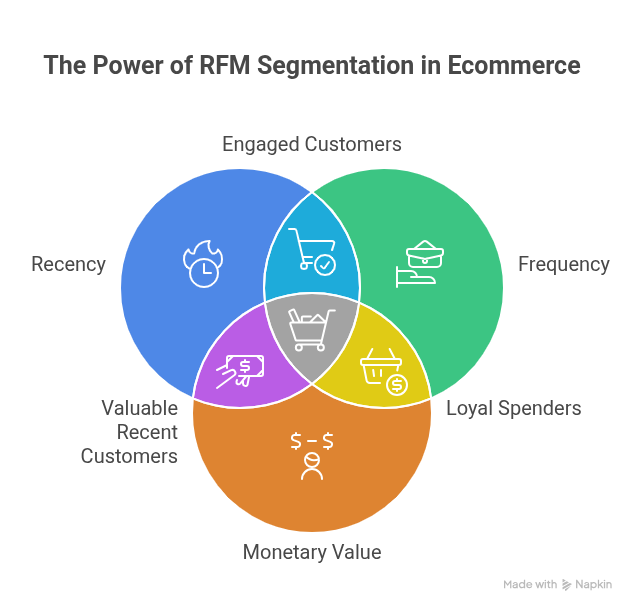
At its core, RFM segmentation is a behavioral model that groups customers based on three measurable actions: recency, frequency, and monetary value. In simple terms, it answers three critical questions. How recently did a customer buy? How often do they buy? How valuable are they to the business?
The model itself dates back to direct mail marketing, long before ecommerce existed. What makes it powerful today is that ecommerce businesses now have cleaner, richer transaction data, making recency frequency monetary segmentation more accurate and easier to automate at scale.
Compared to traditional segmentation methods, RFM focuses entirely on observed behavior. It does not rely on assumptions, personas, or inferred interests. That makes it especially effective for ecommerce, where purchase history is the strongest predictor of future action.
RFM works best when businesses have consistent transactional data and recurring customer interactions. It is less effective for brands with extremely long purchase cycles or very limited repeat behavior, though even in those cases it often provides better insight than demographic segmentation alone.
Understanding the Rfm Framework in Depth
Recency: measuring real purchase intent
Recency measures how recently a customer made a purchase. In ecommerce, recency is one of the strongest indicators of intent because buying behavior decays over time. A customer who purchased last week is statistically far more likely to buy again than one who purchased a year ago.
Recency windows vary by industry. A fashion brand may consider 30 to 60 days as recent, while a furniture retailer may use a much longer window. The key is aligning recency thresholds with natural buying cycles so that the signal reflects real intent rather than arbitrary timelines.
When used correctly, recency directly improves conversion probability. Campaigns triggered by recency consistently outperform static campaigns because they reach customers while interest is still warm.
Frequency: identifying true loyalty
Frequency looks at how often a customer purchases within a given period. This metric separates one-time buyers from customers who have formed a habit around the brand. Importantly, frequency is not just about volume. Two purchases close together may signal trial behavior, while steady repeat purchases over time indicate loyalty.
Frequency thresholds should be set carefully. A customer who buys twice in one month is not necessarily loyal if they never return. High-frequency customers tend to have higher lifetime value and respond better to relationship-driven messaging rather than discounts.
Over time, frequency becomes one of the most reliable predictors of lifetime value, making it central to effective rfm segment creation.
Mone end
Monetary value measures how much a customer has spent in total, not just average order value. This distinction matters because high-value customers may purchase infrequently but contribute disproportionately to revenue.
One common mistake is treating monetary value as a standalone metric. High spend alone does not guarantee loyalty, and focusing only on big spenders can cause brands to neglect emerging high-potential customers. Monetary value becomes most powerful when interpreted alongside recency and frequency, completing the rfm recency frequency monetary picture.
How RFM scoring works in practice
RFM scoring assigns numerical values to each of the three dimensions. Customers are typically ranked on a scale, often from one to five, for recency, frequency, and monetary value. A higher score represents stronger behavior in that category.
For example, a customer who purchased very recently, buys often, and spends heavily would receive high scores across all three dimensions. When these scores are combined, they create a composite RFM score that clearly distinguishes top customers from those at risk of churn.
Interpreting these combined scores allows marketers to move from raw data to actionable insight. Instead of treating all customers the same, teams can design strategies tailored to each behavioral group.
RFM segments explained: from new buyers to brand champions
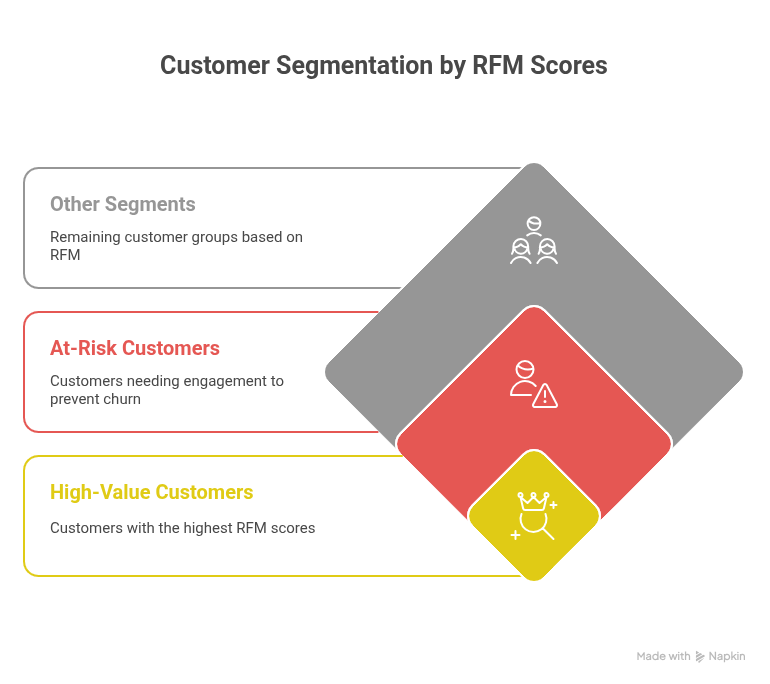
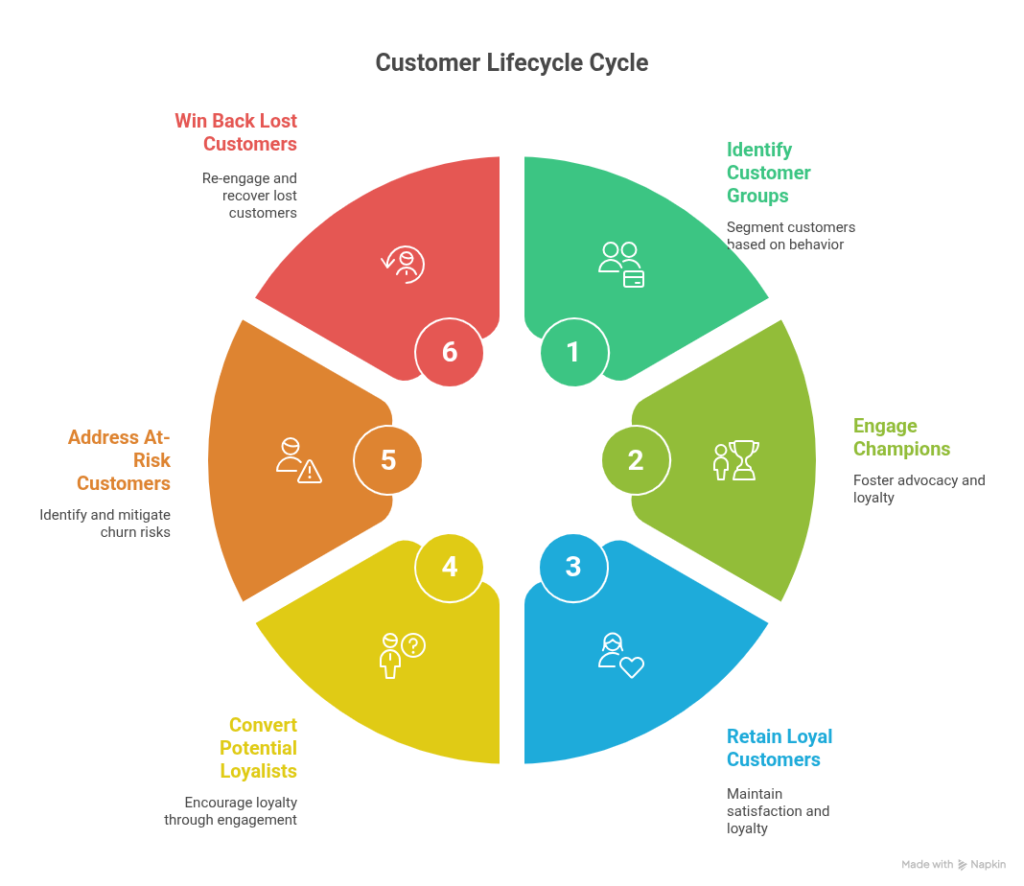
RFM segmentation typically produces several distinct customer groups, each with different business implications. Champions represent customers with high recency, frequency, and monetary value. They are the backbone of revenue and should be protected through loyalty-driven experiences.
Loyal customers purchase frequently but may not always spend the most. Potential loyalists show strong recency but lower frequency, indicating growth potential. New customers score high on recency but low on frequency and monetary value, requiring nurturing rather than aggressive selling.
At-risk customers show declining recency despite strong past behavior, while hibernating and lost customers have low scores across all dimensions. Understanding the business impact of each rfm segment allows marketing teams to allocate effort where it matters most, rather than chasing every customer equally.
How Ecommerce Teams Use Rfm Segmentation
Retention and lifecycle marketing teams rely on recency-based triggers to prevent churn before it happens. Instead of reacting after customers disappear, RFM enables proactive engagement when behavior begins to decline.
Messaging across email, SMS, and push notifications becomes more relevant when informed by RFM. High-frequency customers respond better to exclusivity and early access, while low-recency customers require reminders and reassurance rather than promotions.
On-site personalization improves dramatically when powered by RFM insights. Product recommendations, offers, and messaging can adapt based on where a customer sits in their lifecycle, making customer segmentation behavioral rather than cosmetic.
Paid media teams also benefit by excluding low-intent users and focusing budget on high-value segments, improving ROAS and reducing wasted spend.
Advanced RFM strategies most competitors miss
More mature ecommerce brands combine RFM with cohort analysis to understand how customer behavior evolves over time. Others layer RFM with predictive lifetime value models, allowing them to invest early in customers who show promising behavioral signals.
Subscription and replenishment brands use RFM to detect early signs of churn, while omnichannel retailers unify online and offline data to create a single customer data segmentation framework. These advanced applications turn RFM from a reporting tool into a strategic growth engine.
How to build RFM segmentation step by step
Even the most powerful supply chain optimisation software delivers little value if people avoid using it. User experience plays a decisive role in adoption.
Intuitive interfaces, role-based views, and clear workflows reduce training time and resistance to change. Successful implementations also depend on onboarding support, documentation, and ongoing customer success services. When users understand not just how to use the system, but why it enables better decisions, adoption spreads naturally across functions.
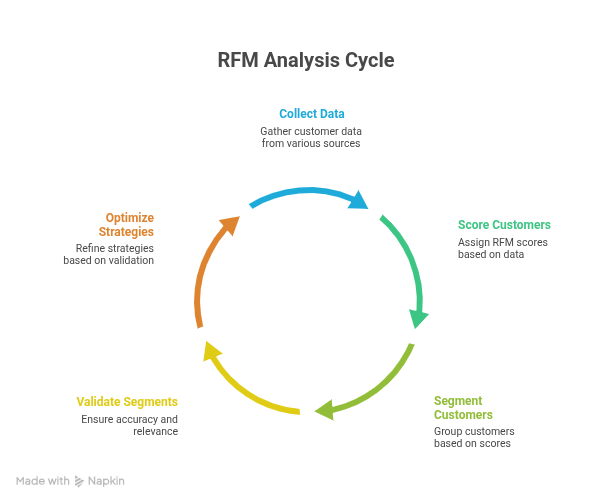
Tools and platforms for RFM segmentation
Most ecommerce platforms provide the raw data needed for RFM, but analysis often requires CRM systems, CDPs, or analytics tools to automate scoring and segmentation. Whether to build in-house or use third-party tools depends on data maturity, team expertise, and scale.
Common RFM mistakes that hurt performance
Over-segmentation can dilute impact, while static RFM scores quickly become outdated. Ignoring seasonality leads to misleading conclusions, and treating all segments equally wastes effort. Successful RFM programs remain focused, dynamic, and tied directly to business outcomes.
Real-world impact of RFM segmentation
Ecommerce brands that adopt RFM consistently report higher retention rates and more efficient marketing spend. Revenue lift often comes not from acquiring more customers, but from better engaging the right ones at the right time. The difference before and after RFM is clarity. Teams stop guessing and start acting on evidence.
Measuring success with RFM segmentation
Success should be measured at the segment level, tracking repeat purchase rate, customer lifetime value, and revenue contribution. Optimization is not a one-time effort but an ongoing process of testing, learning, and refinement.
Conclusion: turning RFM segmentation into a revenue engine
RFM segmentation works because it reflects how customers actually behave, not how we assume they behave. By grounding marketing decisions in recency frequency monetary segmentation, ecommerce brands can improve personalization, retention, and profitability with confidence.
The next step is simple but powerful. Apply RFM consistently, act on its insights, and let data guide every customer interaction.
FAQ Section
1. How do I perform recency frequency monetary analysis on customer data?
Recency frequency monetary analysis is performed by analyzing three data points: how recently a customer purchased, how often they purchase, and how much they spend. Customers are scored for each metric using transaction data and then grouped into meaningful behavioral segments. This turns raw customer data into actionable insights for marketing and retention.
2. How does recency frequency monetary analysis improve targeted marketing campaigns?
RFM analysis improves targeted marketing by aligning campaigns with real customer behavior instead of assumptions. Recent and frequent buyers receive high-intent messaging, while inactive customers are targeted with re-engagement campaigns. This increases relevance, conversions, and marketing efficiency.
3. How can recency frequency monetary analysis help increase customer retention?
RFM analysis helps increase customer retention by identifying early signs of disengagement through declining recency or frequency. Brands can intervene before customers churn by triggering timely, personalized campaigns. This makes retention proactive rather than reactive.
4. Can I use recency frequency monetary analysis on subscription-based businesses?
Yes, RFM analysis works well for subscription-based businesses when metrics are adapted to renewals and engagement. Recency reflects recent activity or renewals, frequency tracks consistency, and monetary value highlights long-term subscribers. Together, they help predict churn and expansion opportunities.
5. How can I perform RFM analysis for customer segmentation using CRM software?
Most CRM platforms already store the data needed for RFM analysis, such as purchase dates, order history, and revenue. Marketers can create segments using built-in filters or automation rules based on recency, frequency, and monetary thresholds. Regular data updates ensure segments stay accurate and actionable.
Ready to Turn Customer Data into High-Impact Ecommerce Growth? We Can Help.
Our RFM-driven customer segmentation solutions help ecommerce brands unlock actionable insights from recency, frequency, and monetary data to improve retention, personalization, and marketing ROI across every channel.